Hosting or driving? What 12,402 EU clinical trials say about Central Europe's place in global pharma
What 12,402 EU clinical trials across all 28 member states actually say about Hungary, Poland, and Central Europe's place in global pharma.

This is part 1 of a three-part series built on the same dataset: all 28 EU and EEA countries’ worth of clinical trial data, pulled through CTIS’s undocumented public API. This piece covers what the data itself says about Central Europe’s place in global pharma. Part 2 takes one finding from here, that trial sites cluster hard around a small set of repeat players EU-wide, and asks what it means for how sponsors actually pick where to run a trial. Part 3 covers how the pipeline itself got built, including the bugs a second, skeptical pass caught that the first one missed.
The EU runs its clinical trial register, CTIS, without a documented public API. That’s
not a complaint, it’s a starting point: a small community has already been quietly
reverse-engineering pieces of it for years. The R package ctrdata is the de facto
reference client for both CTIS and its predecessor register, a Python client called
euclinicaltrials.py exists, and there’s at least one independent write-up and a
community-maintained schema doc covering the same endpoints. ctrdata’s own
documentation already flags one of the trickiest problems you’ll hit: past a certain
page depth, the search endpoint silently stops returning results, regardless of how many
records are actually left.
I built on that. The workaround for the pagination ceiling (query each status code
separately instead of one long paginated sweep, since each slice stays under the limit)
is the same category of fix ctrdata already documents for its own registries. What I
added on top: a second, separate reverse-engineered channel, the internal Dash callback
API behind CTIS’s public trial map, which none of the existing tools touch. Combined,
that’s enough to pull the entire register: 12,402 authorized trials, 218,767 site
records across all 28 EU/EEA countries.
I pointed it first at Hungary and Poland, my own and comparative region, then at the full register once the two-country picture raised more questions than it answered. Here’s what actually holds up once you can check a claim against 26 more countries instead of assuming it.
Central Europe isn’t uniformly “punching above its weight”
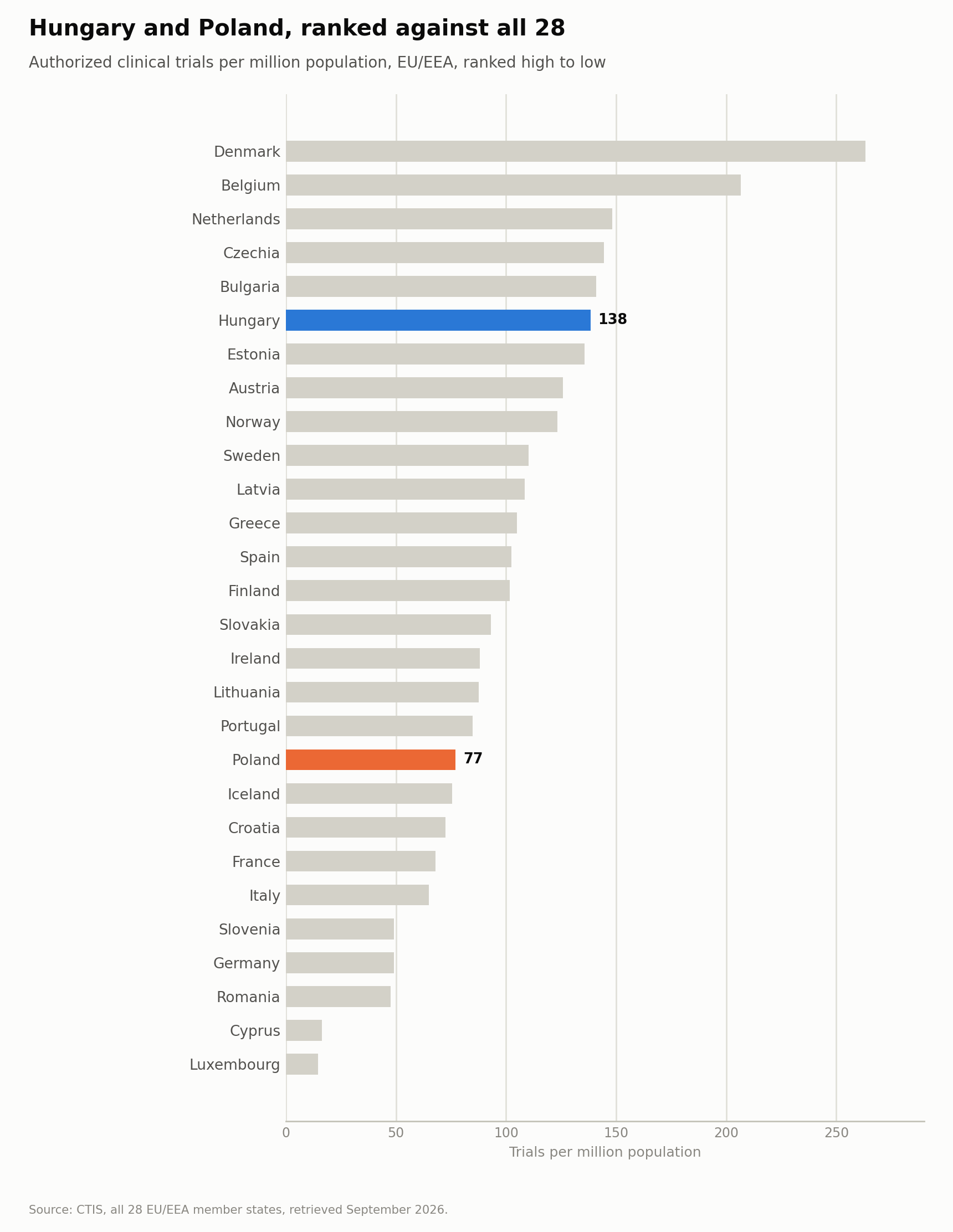
The starting hypothesis, drawn from published research on trial globalization, was that Central and Eastern Europe runs more trials than its population would predict. That’s true, but not evenly. Ranked by trials per million population across all 28 countries, Hungary lands 6th, a genuine, sizeable overshoot. Poland lands 19th, below the EU median, despite running more than twice Hungary’s raw trial volume. Poland’s population is just under four times Hungary’s, so the absolute lead that looks impressive in a two-country comparison turns into an average, even slightly below-average, per-capita rate once you’re ranking against the full field.
The countries running hottest per capita aren’t a CEE bloc at all. Denmark and Belgium top the list, both small, wealthy, and home to real trial infrastructure rather than lower costs. That part isn’t a quirk of this particular register. Drain and colleagues, tracking the global migration of clinical research across a decade of registry data, put the same two countries at or near the top of the world’s trial-density table.¹ Their absolute figures aren’t comparable to mine, and shouldn’t be read side by side: a different register, a different decade, and an annualised rather than cumulative denominator. What survives the change of dataset is the ranking logic, which is the part that matters here. The honest read: small countries with either strong infrastructure or a genuine cost and speed advantage overshoot their population share. CEE membership predicts the second driver more reliably than it predicts the outcome by itself.
The industry-sponsored, not locally-driven, pattern is real and EU-wide
Roughly 92 to 96% of the trials running in Hungary and Poland carry a commercial rather than a domestic academic or public sponsor, and the sponsor names are dominated by the familiar multinational roster. One caveat I’d rather state than have pointed out: CTIS doesn’t expose sponsor country-of-headquarters as a reliable structured field, so “headquartered elsewhere” is an inference from sponsor names and from how thin the domestic biotech sector visibly is, not something the register let me measure directly. That part of the original “hosting, not driving” framing holds up well, and it’s worth pairing with a less flattering but more useful finding: the concentration of trial activity into a small number of hospitals and investigators isn’t a Central European pattern either. It’s how multinational trial site allocation works across the entire EU register. The busiest 10% of trial sites absorb somewhere between 55% and 87% of all site activity in every country with a meaningful sample, France and Spain included. Hungary (69%) and Poland (70%) sit squarely in the middle of that range, not at an outlier extreme.
Poland’s real distinguishing feature isn’t volume, it’s structure
Here’s the finding that didn’t show up in a two-country comparison, because there was nothing to compare it against: roughly a quarter of every trial run in Poland touches a named, commercial site-management organization, a company that builds and operates purpose-built clinical research sites rather than running trials inside a general hospital. Nowhere else in the EU register comes close. Hungary is second at 11% and Bulgaria third at 8%; most of Western Europe sits at 0 to 2%, and for France, Italy, the Netherlands, Belgium and the Nordics the matched share is zero.
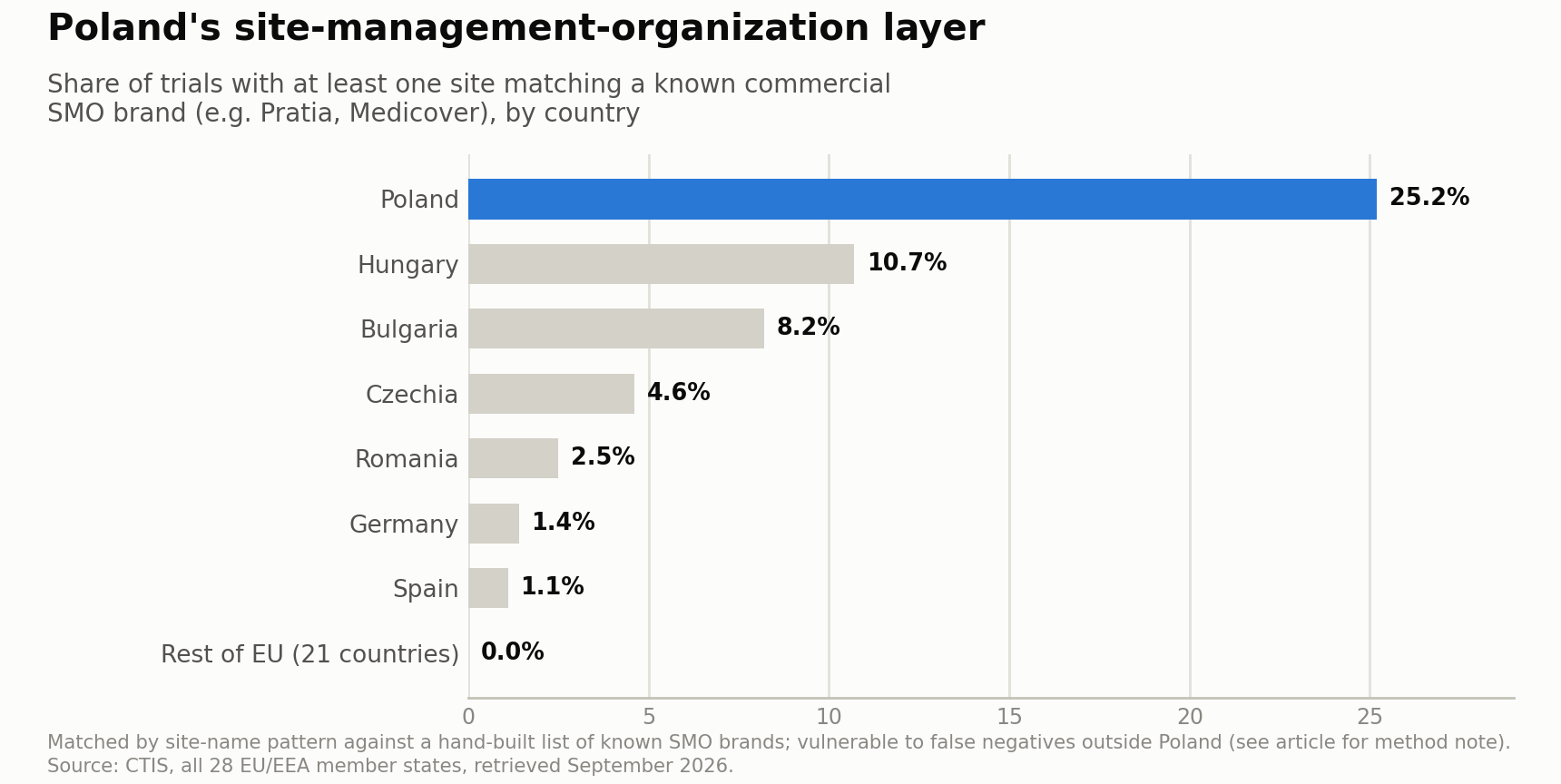
That’s a genuinely different market structure, not a matter of degree. Poland has built a commercial layer of dedicated trial infrastructure that most of the rest of the EU simply doesn’t have at comparable scale, and it’s checkable directly against those companies’ own public marketing material.
The honest limit on that number is worth stating alongside it. It comes from matching site names against a hand-built list of known SMO brands. That method is well defended against false positives, since I checked the matched strings by hand to make sure no unrelated hospital chain sharing a word was being swept in, but it is structurally vulnerable to false negatives. A dedicated commercial trial site operating in Germany or France under a name I didn’t think to look for wouldn’t be counted. So the claim I’d defend is that Poland has a large, visibly brand-named SMO layer and that most of the register doesn’t; the stronger version, that Western European penetration is genuinely near zero, rests on the completeness of a list, and lists can be short. If there’s one number from this whole dataset worth remembering, it’s still this one, not the population-density comparison the original hypothesis started from.
The GLP-1 wave shows up in a public register in near real time
A simple keyword scan for obesity, GLP-1, semaglutide, and related terms across trial descriptions climbs from 3 flagged trials in 2022 to roughly 50 a year by 2024, and it stays elevated through 2025 and 2026, with the 2026 figure covering a partial year because the data was pulled in September. That tracks the well-reported global GLP-1 pipeline boom almost exactly, and it’s visible directly in public regulatory data well before it shows up in most industry commentary. If you want a live read on where pharma’s R&D attention is actually going, an unglamorous government register turns out to be a surprisingly good instrument.
The mental model worth keeping
Central Europe hosts far more clinical research than its size would suggest, and it does so almost entirely on behalf of sponsors headquartered somewhere else. That’s the “hosting, not driving” part, and it’s real. But treating the whole region as interchangeable “cheap capacity” misses what’s actually distinctive: Hungary’s advantage looks structural and regulatory (fast, population-adjusted overshoot); Poland’s looks commercial and organizational (a site-management layer nobody else in the region has built at the same scale). Neither is reducible to the other, and neither is reducible to “cheap location.” A public register nobody officially built an API for turns out to say all of this clearly, once you’re willing to ask it the right questions and check the answer against enough countries to trust it.
Data: EU Clinical Trials Information System (CTIS), all 28 member states, retrieved September 2026 via its undocumented public API. EMA’s own FAQ describes the register as “not an analytical tool,” and none of the figures above reflect actual patient enrollment, only authorized and planned trial data. All figures are aggregate, country- or organization-level; no individual patient or investigator data appears in this piece.
1. Drain, P. K., Parker, R. A., Robine, M., & Holmes, K. K. (2018). Global migration of clinical research during the era of trial registration. PLOS ONE, 13, e0192413.